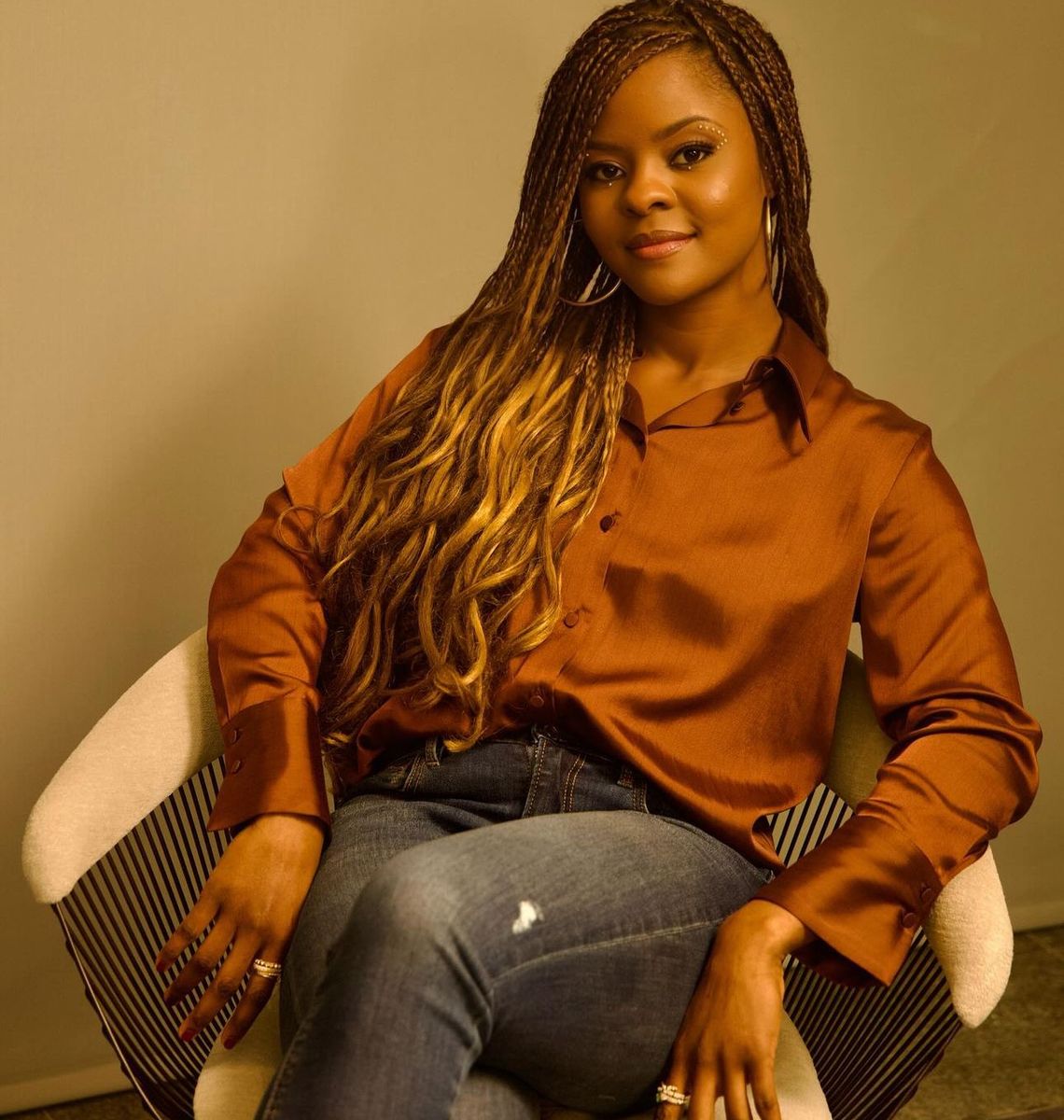

Nathan Nwachuku & Maxwell Maduka: CEO & CTO of Terra Industries.
It’s a Monday evening, and the Wi-Fi gods of Lagos are doing their usual tap dance with me, connecting, disconnecting, reconnecting like they’re testing my faith. I’m working out of a café on the Island, and on the other side of my screen sits the twenty-two-year-old CEO of Terra Industries, Nathan Nwachuku, deep inside Africa’s largest drone factory in Abuja. The drone factory that he and his co-founder, Maxwell Maduka, built.
In the background, there's movement, engineers, and machines – that we struggle a bit to hear each other. The activity in the background represents the sheer scale of Terra’s ambition to protect Africa’s security infrastructure. At this level, you don’t just hear the ambition, you feel it. Any less activity, and it could have been classified as your run-of-the-mill manufacturing facility.
It’s the second time in three weeks that Nathan has spoken with tech media. Weeks ago, the two-year-old startup announced $11.75 million in seed funding – one of the largest seed raises in Africa, and in proximity to its US counterpart, Anduril Industries, $17.6 million in seed funding.
In the weeks since then, Terra Industries (formerly known as TerraHaptix) raised a $22 million bridge round in record time, in addition to the $11.8 million they raised earlier, bringing their total funding to $34 million. That’s a lot of money for founders in their early 20s, and yet, when you talk to Nathan, the scale begins to make unnerving sense.
I think more investors are finally understanding that at the current trajectory of the continent, if we do not lay a modern security infrastructure, Africa is doomed.

Archer - built by Terra.
The unplanned raise was inevitable
“It was never planned”, Nathan says. “We had no idea there would be a bridge round until a week after the seed round. Lux Capital pre-empted this extension, which was built on the momentum from the company's commercial and government contracts, and the immense need the company had in expanding manufacturing capacity to meet demand”.
The round came together in under two weeks, record time – with a band of existing investors and new investors, including Resilience17, the Family Office of Flutterwave’s CEO & Founder, Olugbenga “GB” Agboola, and talented Hollywood Actor and infamous Joker, Jared Leto. Yes. That Jared Leto.
Part of Terra’s allure to governments and investors is its connection to reshaping Africa’s future – if it succeeds.
Africa’s existential issue lies with security, banditry, terrorism, vandalism of critical national assets like railway infrastructure, oil and gas pipelines, power transmission cables, etc.
Anytime these assets are compromised, it sets Africa back decades.
Terra’s investors understand this. “I think more investors are finally understanding that at the current trajectory of the continent, if we do not lay a modern security infrastructure, Africa is doomed”. He added.
Conspiracies are best served at breakfast
Admitting American investors on Terra’s cap table, especially from the fruit of Palantir’s tree, was controversial. When Terra announced its seed raise weeks earlier and revealed it was led by 8VC’s Joe Lonsdale, the co-founder of Palantir, with Alex Moore, the Chairman of Palantir’s board of directors, joining Terra’s board, social media erupted.
Co-founders Nathan Nwachuku and Maxwell Maduka were accused of exposing Nigeria’s defence systems and data to the US, and worst of all, they claimed, Palantir.
Nathan understood the criticism but was adamant about the veracity. “We are not providing the US with access to our data or hardware; that’s inaccurate. “The Americans see Africa as a strategic geopolitical partner. They want to ensure that Africa can build out its own surface capability to protect itself”.
There’s truth in that. Africa’s security problems aren’t new; what’s new is the idea that Africans could solve them locally, without outsourcing to foreign defence institutions – that Africa fixes its security infrastructure with its own systems, codes and principles of sovereignty.
Fintech is good, but we can’t keep building the five-hundredth payments app when we still don’t have stable power grids, secure borders, or reliable food systems.”
What’s missing in Africa?
“The problem,” Nathan says, “is that most African investors don’t invest based on philosophy. They invest in markets they understand.”
By markets, he means fintech. Payments. The safety of sameness. “Fintech is good,” he concedes, “but we can’t keep building the five-hundredth payments app when we still don’t have stable power grids, secure borders, or reliable food systems.”
He digs into the Four Pillars of Civilisation:
Energy: Owned by Dangote Refinery.
Security: Owned, someday, by Terra.
Connectivity: ?
Food production: ?
“If we don’t fix these, we can’t build anything else.”
Nathan’s ethos is that security isn’t a feature to be monetised; it’s “the bedrock of industrialisation”. If you’re wondering why investors are investing in Terra so quickly, there’s your answer.
If we don’t fix these, we can’t build anything else.

Iroko - built by Terra.
Cap tables
Nathan doesn’t want “tourist investors.” Terra’s latest cap table has global endorsements from Hollywood to African fintech royalty, including Lux Capital, 8VC, Tofino Capital, Nova Global, Silent Ventures, and Belief Capital.
Jared Leto joined Terra’s round with some colour. Jared is a prolific investor with investments across AI and Fintech. His portfolio includes high-growth companies such as Reddit, Robinhood, Uber, and Stripe. It was a no-brainer to invest in a couple of ambitious young founders from Nigeria.
Olugbenga “GB” Agboola’s cameo on the cap table made sense for Terra, because he knows a few things about building at scale in Africa.
“GB is an icon,” Nathan tells me. “He’s navigated business-to-government, built compliance from scratch, and learned how to survive tough markets. Those skills translate directly into defence.”
He added, “GB is incredibly brilliant and sees things from a philosophical point of view. It was clear to us that GB has many skills and knowledge that are transferable to defence, particularly in government relations, as we expand across markets. What GB has built has transformed the continent, so it was a no-brainer for us, and I’m very glad to have him on board”.
“GB is incredibly brilliant and sees things from a philosophical point of view. It was clear to us that GB has many skills and knowledge that are transferable to defence, particularly in government relations, as we expand across markets. What GB has built has transformed the continent, so it was a no-brainer for us and I’m very glad to have him on board”.
The factory floor
Halfway through the call, I hear a distant thrum of machines and employees shouting over the noise. Terra’s factory floor in Abuja is alive.
“Sometimes,” Nathan says, “we work overnight. The schedule depends on what needs to get done.”
They’re expanding. Adding another 20,000 square feet to the factory and quietly constructing a “mega facility” in a new market. By the end of the year, he expects to have 100 employees across three cities: Abuja, London, and San Francisco, attracting African talent from OpenAI, Tesla, and Google.
“We know they won’t all move home,” he says, “so we’ll bring the motherland to them.”

Factory floor.
We know they won’t all move home,” he says, “so we’ll bring the motherland to them.
What Nathan eats for breakfast
When I ask what time he wakes up, he answers: “Four a.m.”
No alarm. Just his body clock. He eats five boiled eggs for breakfast, prepared by his chef. No bread, butter, or tea.
His mornings are soundtracked by wordless synthwave. I asked about that. “I hate words in my music. They distract me from daydreaming.”
Nathan’s day-to-day is structureless, no “typical Monday.” Eighty per cent of his time goes to business development, ten per cent to investors, and whatever remains to family.
Sleep comes late, often past midnight. He doesn’t mention rest. Tough job.
When I ask what he dreams about that isn’t Terra, he doesn’t pause.
“Nuclear power,” he says. “That’s the next holy grail.”
After security, he believes energy will define Africa’s future: its population, growth rate, and inevitable energy deficit. “There’s no other way to sustain the continent except nuclear,” he insists.

Factory floor.
A new unicorn emerges 🦄
Building software and hardware is a daunting and expensive venture. Nathan believes Terra will continue to raise millions and billions to fuel its ambitions.
The two-year-old startup is on a generational run and breaking fundraising records. Raising $11.8 million in a seed round, plus a $22 million extension in two weeks, at a nine-figure valuation, is the type of trust signal that African startups don’t always witness.
And here we are, witnessing the unique trajectory of a company that will become the most consequential African startup of this decade.
Its rapid rise to unicorn status won’t be a surprise to anyone who’s paying attention. The only question to ask, is when?