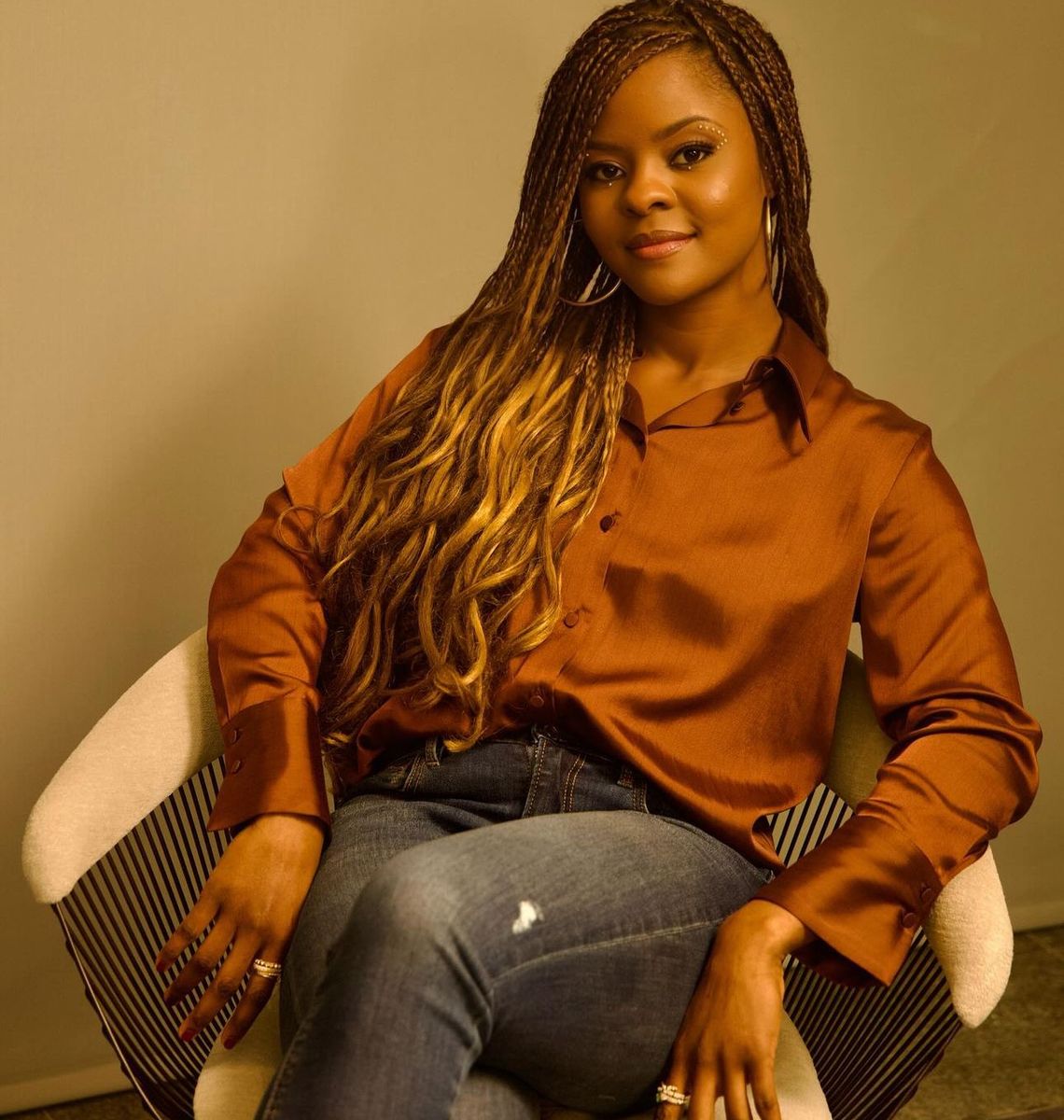

Funke Opeke. Founder, MainOne.
Funke Opeke laid the cables that expanded internet access across West Africa, sold the company for $320 million – still the largest tech acquisition in Nigeria to date and the first landmark deal by an African female CEO.
And she’s only getting started.
I had been looking forward to this meeting for months, and the time had come to meet one of the most remarkable entrepreneurs of this generation.
Funke Opeke, the founder and CEO of MainOne, the woman who effectively gave West Africa its internet backbone and the architect of the continent’s most significant technology infrastructure acquisition, was meeting me on a Monday afternoon at Godaïf Village in Ikoyi, one of my favourite cafes in Lagos.
I had questions prepared. I had a voice recorder ready. I had also spent a non-trivial amount of time thinking about what to call her, because I am Nigerian, and my Nigerianness would not allow me simply call her, an accomplished woman in her 60s, “Funke.”
When she arrived, wearing a beautiful Ankara dress and looking well-rested for someone who was on her fourth meeting of the day, I asked if I could give her a hug. She said yes. Then I told her, honestly, that I could not bring myself to address her by her first name.
She smiled. She suggested FKO, her initials. Or, offered, our shared initial: FO. We settled on FKO.
Funke Opeke laid the cables that expanded internet access across West Africa, sold the company for $320 million – still the largest tech acquisition in Nigeria to date and the first landmark deal by an African female CEO.
FKO is technically on spring break. She is a fellow at Harvard University, deep in what she describes as a reflective, transitional period — her “third chapter,” in her words — and she was visiting Lagos, which she had told herself would be restful. White space on the calendar. Time to breathe.
“I thought I would have a lot of time,” she says, “and I’m finding I’m still overbooked and overcommitted.”
“So, you haven’t taken your foot off the gas,” I say.
“I am,” she says, then pauses. “That’s the scary thing, because I thought I was.”
I ask if she’s a restless person. She corrects me.
“I’m not a restless person. But people believe I can’t stay not busy.” The distinction matters to her. Restlessness is something you run from.
What FKO has is something she runs toward, a persistent intellectual curiosity that has been directing her life since she was a young girl in Queen’s School, Ibadan, going to the library because the journals were there and the world in them was interesting. “Maybe that always spurs me to want to do things,” she says. “But it’s tough for me to just be.
Coming up in the world
FKO’s early education was at Queen’s School, where she thrived. She wanted to follow her sister and cousins there; her parents had pushed for International School, which had a richer curriculum; she cried daily until they relented and sent her to Queen’s.
At Queen’s, she promptly did exactly what she would have done anywhere: went to the library, read the journals, and started thinking about things happening in other places. She thought briefly about nursing. Then she discovered physics and cybernetics, and that was that.
She went to Columbia University for graduate school, without any firm plan to stay in the US. “I went with the intention of just learning,” she says. The gap between Nigeria and America did not feel insurmountable to her.
In those years, she says, Nigerians thought differently about the distance between where they were and what was possible. “We thought we could build computer and chip factories here.” There was an ambition in the national imagination, she suggests, that has since been retired.
A professor at Columbia told her that everything she was learning could not be taken back to Nigeria because the infrastructure did not exist to apply it. She did not march out of that lecture hall burning with determination to prove him wrong. The comment stayed with her, a dormant thing, waiting for the right conditions.
It would wait almost twenty years.
I went with the intention of just learning.

Year 2016: L-R: Olusola Oworu, Hon. Commissioner, Commerce & Industry, Lagos State; Fola Adeola, Chairman, MainOne; Omobola Johnson, Hon. Minister of Communications Technology; and Funke Opeke, Founder & CEO, MainOne, at the launch of MainOne’s new Tier III Data Centre, MDX-i. Image credit: IT News Africa.
Keep the main thing the main thing
When Nigeria’s mobile evolution began in the early 2000s and the environment finally existed where she could apply what she had learned at Columbia, she returned as Chief Technology Officer of MTN Nigeria.
What she found was this: millions of Nigerians were getting mobile phones. The last mile was beginning to work. But the infrastructure that aggregates all that traffic and moves it globally was inadequate. You could have a signal, but you would not have the internet it was supposed to connect you to. The international submarine cable capacity did not exist.
Following her stint at MTN, she worked at NITEL, the state telecoms company. Her mentor, Fola Adeola, had brought her in to help privatise it.
That didn’t work.
“It was just a mess when the thing crashed,” she says. Most people, at that point, would have been done. She had an American passport, a nest egg, and a life in America, if she wanted it.
Instead, she decided to build the submarine cables herself.
Fola Adeola, the man who had brought her to NITEL, told her that her plan to build submarine cables herself was too ambitious and to find something more realistic to do. Something consistent with her values. He would help.
“I said: ‘No. Let me do more work. You don’t have to do anything right now. I want you to be on an advisory board, but let me come back and update you.’
At this point, I say, “You tried NITEL, and it didn’t work. Your mentor is telling you it’s too ambitious. You have an American passport and a life you could go back to. What kept you going?”
“I must have had the conviction,” she says. Then: “I think I was probably a little bit insane.” She laughs.
I think I was probably a little bit insane.
The early days of trying to get support for MainOne were tough.
She went to the African Development Bank with a two-paragraph write-up and business cards printed around the corner.
The World Bank turned her away. People said she couldn’t do it, and others advised her to do a feasibility study and build a business case.
So, she did.
She commissioned a feasibility study, hired a technical consultant, and engaged a financial advisory firm. She built the business case that the two-paragraph write-up had gestured toward. And when Emerging Capital Partners gave her the first term sheet – when someone with money decided her idea was feasible – that was the catalyst.
MainOne cost $240 million to build, a mix of debt and equity. For years, FKO ran it through conditions that would have ended most businesses. The naira moved from ₦120 to the dollar when she started to roughly ₦1,600 by the time the company was acquired. A devaluation so lethal that a company whose inputs were almost entirely dollar-denominated had to fight for its economics on top of every other fight.

Funke Opeke.
Cash is King
In 2022, Equinix acquired MainOne for $320 million in cash. All-cash. Every investor paid back. Every debt settled. Shareholders who had been with her for over a decade received returns that, given the risk profile of the Nigerian market, she describes as fair – and by the math of what they put in and what they got out, considerably more than that.
The reactions from the world were, as they often are, a projection. Critics questioned the sale price.
Was it underpriced? I ask.
“No,” she says. She walks me through the math – $240 million to build. Cash return on day one. “I feel it was a fair price,” she says. “From our standpoint, from the investor and shareholder standpoint.”
And was MainOne her baby? Did she grieve selling the company?
“I don’t have that emotional thing that oh, my baby. I don’t have that at all, at all, at all.”
“My baby had grown up,” she says, and moves on.
Succession is essential
From the very first meeting with Fola Adeola in 2009, FKO had been planning her succession. If something happened to her, there was a plan.
Succession and sustainability were always in the frame. “This was not a vanity project,” she says. “It wasn’t about me.” By the time the sale happened, a new Managing Director had been in place for five months. The transition had already happened.
I asked if she’d made any big-girl purchase since MainOne’s acquisition.
“No”. She said. Nothing ostentatious.
Since the acquisition, she took a girls’ trip to Cape Town with former colleagues and a safari with her sisters. She relocated to Princeton, New Jersey, to be closer to her son, who lives in New York. She did not buy a Ferrari. She has not hired a chef.
“Much to the chagrin of everyone around me,” she says, with amusement.
She still cooks her own food — vegetables first, then beans, then fish — because she is particular about ingredients, and what she puts in her body. She likes knowing exactly what is going into her food, which, she notes, is also how she has always approached everything else.
Now she is at Harvard, in a fellowship she describes as a deliberate attempt to think carefully about what comes next before the next thing starts happening on its own. She calls it her third chapter. It is already filling up with meetings, while she gathers data on the next problem, waiting for the mission to come fully into focus.
“I’m starting to see the pattern repeat itself,” she says, and she almost laughs. She had thought she was on vacation. The mission had other ideas.
This was not a vanity project. It wasn't about me.
Third chapters
What she was, and what she still is, is mission-driven. Ambition is personal. Mission is external. Ambition says, “I want to be this.” Mission says: “This problem exists, and I can solve it.”
For FKO, the problem was infrastructure. Too many young Nigerians were sitting idly with nothing to do, and if they had access to information — real access, they could improve themselves. Close that gap, and good things would follow.
The mission was to close that gap. The $320 million acquisition was what happened when she closed it well enough for long enough.
“So that’s me,” she says. “What do we need to do? What do we need to achieve? That’s all.”
⸻
I ask her, near the end of our conversation, whether her dreams have come true.
She considers this carefully. Personally, she is comfortable. She does not need to work. Her life, by any material measure, is a success. But personal comfort, for FKO, was never the dream.
“My dreams haven’t come true,” she says, “because as a Nigerian, our society is not where it needs to be.”
What she dreams of is a Nigeria that is safe, secure, and productive. A Nigeria where the culture of dependency is replaced by innovation, where young people are globally competitive, where companies of real scale are being built, not despite the environment but because of it.
“I don’t feel we have less intellectual capacity than any other part of the world,” she says. The gap is not talent. The gap is the infrastructure that the talent needs to become something.
When I ask how she rests, she says, “Rest and relaxation are different things. Rest is sleep, which I don’t get enough of. Relaxation is travel — somewhere walkable, with nature nearby, where the sea is accessible, and the city does not swallow everything.”
She loved Sydney, Australia, when she visited last year. Cape Town, she has always loved. Nairobi, she adds, where you can take a walk in Karura Forest and feel the city release its grip.
The afternoon is moving on. She has a meeting to get to.
She walks out of Godaïf and into the bright Ikoyi afternoon, and I think about what she said about her professor at Columbia, the one who told her that everything she was learning could not be applied back home because the infrastructure didn’t exist.
And I think of what she’s accomplished since that conversation.
There is no greater manifestation of grit.